PRODUCT FILTER
Categories
Type
Type

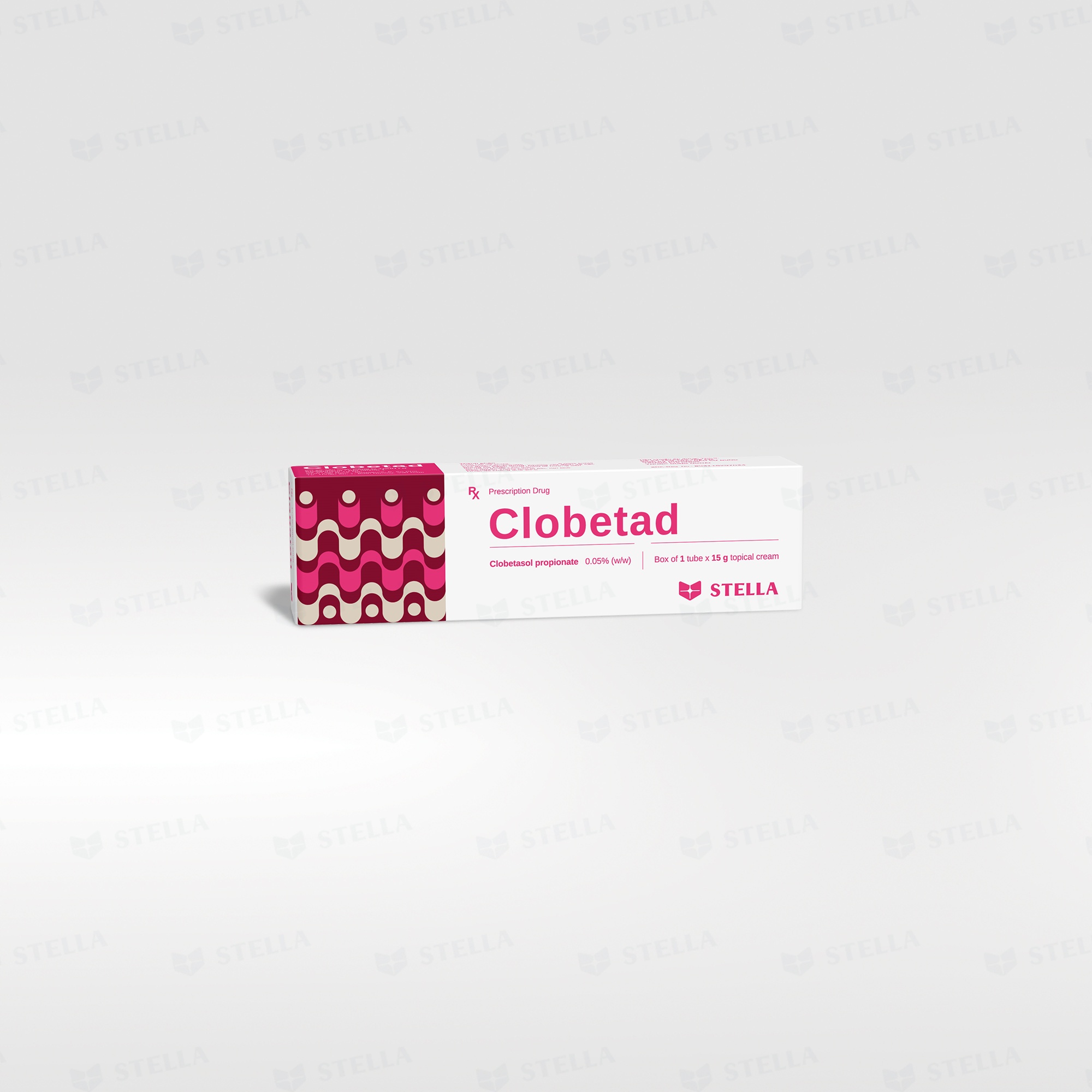
Clobetad
Rx

Clobetasol propionate is a topical corticosteroids, have anti-inflammatory, antipruritic, and vasoconstrictive properties.

Pack size Box of 01 tube of 15 g, Box of 01 tube of 30 g
Shelf-life 24 months
Composition Clobetasol propionate
Dosage forms and strengths Topical cream: Clobetasol propionate 0.05% (w/w)
Product code :

PRESCRIBING INFORMATION

Indications

Clobetad is indicated for adults, elderly and children over 1 year for the short term treatment only of more resistant inflammatory and pruritic manifestations of steroid responsive dermatoses unresponsive to less potent corticosteroids, include:

  • Psoriasis (excluding widespread plaque psoriasis),
  • Recalcitrant dermatoses,
  • Lichen planus,
  • Discoid lupus erythematosus,
  • Other skin conditions which do not respond satisfactorily to less potent steroids.

Dosage

  • Clobetasol propionate belongs to the most potent class of topical corticosteroids and prolonged use may result in serious undesirable effects. If treatment with a local corticosteroid is clinically justified beyond 4 weeks, a less potent corticosteroid preparation should be considered. Repeated but short courses of clobetasol propionate may be used to control exacerbations.
  • Adults, elderly and children over 1 year
    Apply thinly and gently rub in using only enough to cover the entire affected area once or twice a day until improvement occurs, then reduce the frequency of application or change the treatment to a less potent preparation. Allow adequate time for absorption after each application before applying an emollient.
    Repeated short courses of clobetasol propionate may be used to control exacerbations.
    In more resistant lesions, especially where there is hyperkeratosis, the effect of clobetasol can be enhanced, if necessary, by occluding the treatment area with polythene film. Overnight occlusion only is usually adequate to bring about a satisfactory response. Thereafter improvement can usually be maintained by application without occlusion.
    If the condition worsens or does not improve within 2 – 4 weeks, treatment and diagnosis should be re-evaluated.
    Treatment should not be continued for more than 4 weeks. If continuous treatment is necessary, a less potent preparation should be used.
    The maximum weekly dose should not exceed 50 g/week.
    Therapy with clobetasol should be gradually discontinued once control is achieved and an emollient continued as maintenance therapy.
    Rebound of pre-existing dermatoses can occur with abrupt discontinuation of clobetasol.
    Recalcitrant dermatoses: Patients who frequently relapse
    Once an acute episode has been treated effectively with a continuous course of topical corticosteroid, intermittent dosing (once daily, twice weekly, without occlusion) may be considered. This has been shown to be helpful in reducing the frequency of relapse.
    Application should be continued to all previously affected sites or to known sites of potential relapse. This regimen should be combined with routine daily use of emollients. The condition and the benefits and risks of continued treatment must be re-evaluated on a regular basis.
  • Paediatric population
    Clobetad is contraindicated in children under 1 year of age.
    Children are more likely to develop local and systemic side effects of topical corticosteroids and, in general, require shorter courses and less potent agents than adults.
    Care should be taken when using clobetasol propionate to ensure the amount applied is the minimum that provides therapeutic benefit.
    Duration of treatment for children and infants: Courses should be limited if possible to five days and reviewed weekly. Occlusion should not be used.
    Application to the face: Courses should be limited to five days if possible and occlusion should not be used.
  • Elderly
    Clinical studies have not identified differences in responses between the elderly and younger patients. The greater frequency of decreased hepatic or renal function in the elderly may delay elimination if systemic absorption occurs. Therefore the minimum quantity should be used for the shortest duration to achieve the desired clinical benefit.
  • Renal/hepatic impairment
    In case of systemic absorption (when application is over a large surface area for a prolonged period) metabolism and elimination may be delayed therefore increasing the risk of systemic toxicity. Therefore the minimum quantity should be used for the shortest duration to achieve the desired clinical benefit.

Usage

  • For external use only, especially appropriate for moist or weeping surfaces.
  • Hypersensitivity to any of the ingredients in the preparation,
  • Untreated cutaneous infections,
  • Rosacea,
  • Acne vulgaris,
  • Pruritus without inflammation,
  • Perianal and genital pruritus,
  • Perioral dermatitis,
  • Clobetad is contraindicated in dermatoses in children under 1 year of age, including dermatitis and nappy eruptions.


Common

  • Pruritus,
  • Local skin burning/skin pain.
  • Cases of osteonecrosis serious infections (including necrotizing fasciitis) and systemic immunosuppression (sometimes resulting in reversible Kaposi’s sarcoma lesions) have been reported with long-term use of clobetasol propionate beyond the recommended doses. In some cases patients used concomitantly other potent oral/topical corticosteroids or immunosuppressors (e.g. methotrexate, mycophenolate mofetil). If treatment with local corticosteroids is clinically justified beyond 4 weeks, a less potent corticosteroid preparation should be considered.
  • Clobetasol should be used with caution in patients with a history of local hypersensitivity to other corticosteroids or to any of the excipients in the preparation. Local hypersensitivity reactions (see section 12. Adverse reactions) may resemble symptoms of the condition under treatment.
  • Manifestations of hypercortisolism (Cushing’s syndrome) and reversible hypothalamic-pituitary-adrenal (HPA) axis suppression, leading to glucocorticosteroid insufficiency, can occur in some individuals as a result of increased systemic absorption of topical steroids. If either of the above are observed, withdraw the drug gradually by reducing the frequency of application, or by substituting a less potent corticosteroid. Abrupt withdrawal of treatment may result in glucocorticosteroid insufficiency (see section 12. Adverse reactions).
  • Risk factors for increased systemic effects are:
    – Potency and formulation of topical steroid,
    – Duration of exposure,
    – Application to a large surface area,
    – Use on occluded areas of skin (e.g. on intertriginous areas or under occlusive dressings (in infants the nappy may act as an occlusive dressing)),
    – Increasing hydration of the stratum corneum,
    – Use on thin skin areas such as the face,
    – Use on broken skin or other conditions where the skin barrier may be impaired,
    – In comparison with adults, children and infants may absorb proportionally larger amounts of topical corticosteroids and thus be more susceptible to systemic adverse effects. This is because children have an immature skin barrier and a greater surface area to body weight ratio compared with adults.
  • Paediatric population
    In infants and children under 12 years of age, long-term continuous topical corticosteroid therapy should be avoided where possible, as adrenal suppression can occur.
    Children are more susceptible to develop atrophic changes with the use of topical corticosteroids.
  • Duration of treatment for children
    Courses should be limited if possible to five days and reviewed weekly. Occlusion should not be used.
  • Infection risk with occlusion
    Bacterial infection is encouraged by the warm, moist conditions within skin folds or caused by occlusive dressings. When using occlusive dressings, the skin should be cleansed before a fresh dressing is applied.
  • Use in psoriasis
    Topical corticosteroids should be used with caution in psoriasis as rebound relapses, development of tolerances, risk of generalised pustular psoriasis and development of local or systemic toxicity due to impaired barrier function of the skin have been reported in some cases. If used in psoriasis careful patient supervision is important.
  • Concomitant infection
    Appropriate antimicrobial therapy should be used whenever treating inflammatory lesions which have become infected. Any spread of infection requires withdrawal of topical corticosteroid therapy and administration of appropriate antimicrobial therapy.
  • Chronic leg ulcers
    Topical corticosteroids are sometimes used to treat the dermatitis around chronic leg ulcers. However, this use may be associated with a higher occurrence of local hypersensitivity reactions and an increased risk of local infection.
  • Application to the face
    Application to the face is undesirable as this area is more susceptible to atrophic changes. If used on the face, treatment should be limited to 5 days.
  • Application to the eyelids
    If applied to the eyelids, care is needed to ensure that the preparation does not enter the eye, as cataract and glaucoma might result from repeated exposure. If clobetasol does enter the eye, the affected eye should be bathed in copious amounts of water.
  • Visual disturbance
    Visual disturbance has been reported with systemic and topical corticosteroid use. If a patient presents with symptoms such as blurred vision or other visual disturbances, the patient should be considered for referral to an ophthalmologist
    for evaluation of possible causes which may include cataract, glaucoma or rare diseases such as central serous chorioretinopathy (CSCR) which have been reported after use of systemic and topical corticosteroids.
  • Topical steroid withdrawal syndrome
    Long term continuous or inappropriate use of topical steroids can result in the development of rebound flares after stopping treatment (topical steroid withdrawal syndrome). A severe form of rebound flare can develop which takes the form of a dermatitis with intense redness, stinging and burning that can spread beyond the initial treatment area. It is more likely to occur when delicate skin sites such as the face and flexures are treated. Should there be a reoccurrence of the condition within days to weeks after successful treatment a withdrawal reaction should be suspected. Reapplication should be with caution and specialist advise is recommended in these cases or other treatment options should be considered.
  • Clobetad contains:
    – Approximately 470 mg propylene glycol per gram of product. Propylene glycol may cause skin irritation.
    – Cetostearyl alcohol, which may cause local skin reactions (e.g. contact dermatitis).
    – Chlorocresol, which may cause allergic reactions.
    – Paraffin, therefore instruct patients not to smoke or go near naked flames due to the risk of severe burns. Fabric (clothing, bedding, dressings etc) that has been in contact with this product burns more easily and is a serious fire hazard. Washing clothing and bedding may reduce product build-up but not totally remove it.
  • There are limited data from the use of clobetasol in pregnant women. Topical administration of corticosteroids to pregnant animals can cause abnormalities of foetal development. The relevance of this finding to humans has not been established. Administration of clobetasol during pregnancy should only be considered if the expected benefit to the mother outweighs the risk to the foetus. The minimum quantity should be used for the minimum duration.
  • The safe use of topical corticosteroids during lactation has not been established. It is not known whether the topical administration of corticosteroids could result in sufficient systemic absorption to produce detectable amounts in breast milk. Administration of clobetasol during lactation should only be considered if the expected benefit to the mother outweighs the risk to the infant. If used during lactation clobetasol should not be applied to the breasts to avoid accidental ingestion by the infant.
  • There have been no studies to investigate the effect of clobetasol on driving performance or the ability to operate machinery. A detrimental effect on such activities would not be anticipated from the adverse reaction profile of topical clobetasol.