PRODUCT FILTER
Categories
Type
Type

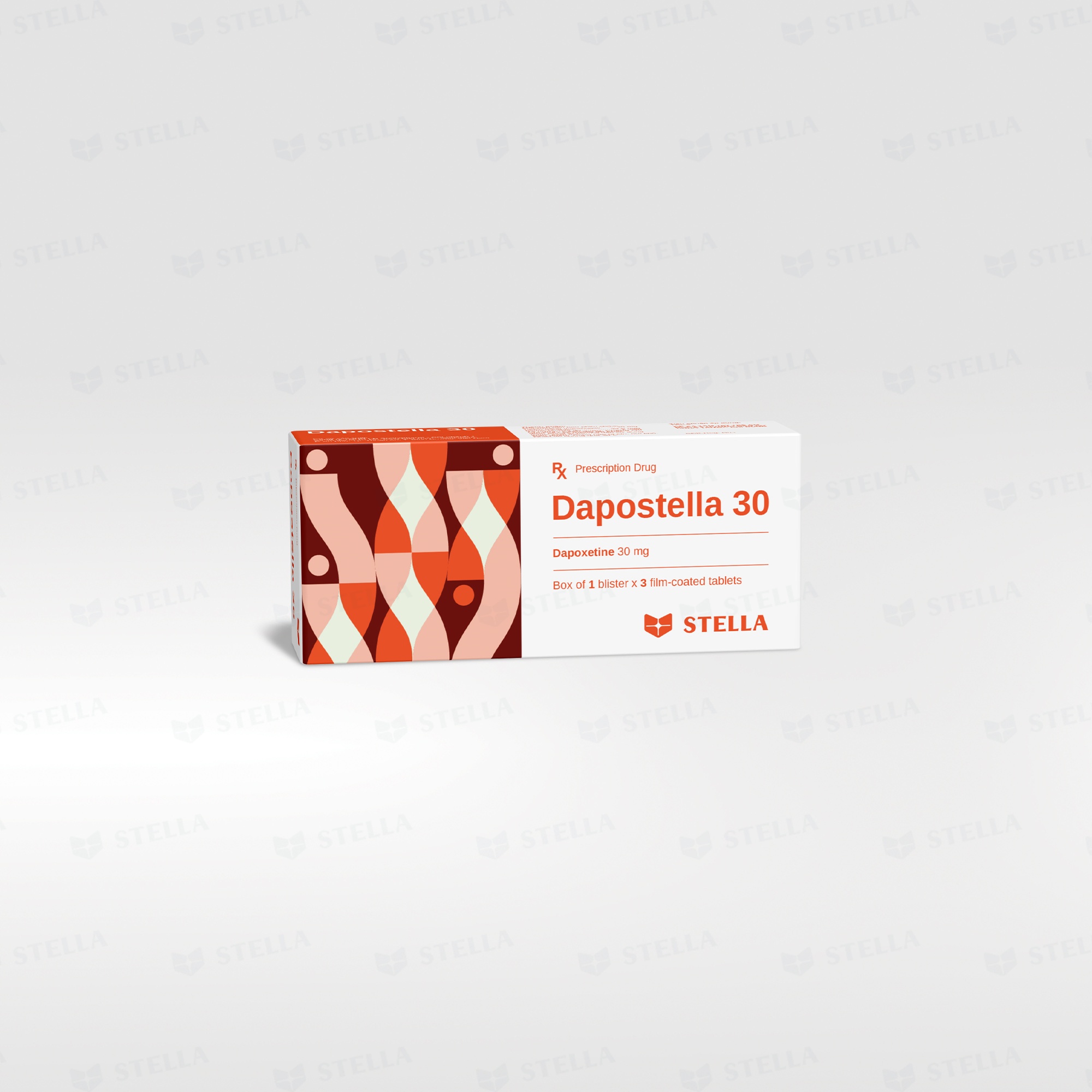
Dapostella 30
Rx

The mechanism of action of dapoxetine in premature ejaculation is presumed to be linked to the inhibition of neuronal reuptake of serotonin and the subsequent potentiation of the neurotransmitter’s action at pre- and postsynaptic receptors

Pack size Box of 3 tablets, 6 tablets
Shelf-life 24 months
Composition Dapoxetine
Dosage forms and strengths Film-coated tablet: 30 mg
Product code :

PRESCRIBING INFORMATION

Indications

  • For the treatment of premature ejaculation (PE) in adult men aged 18 to 64 years who meet all the following criteria:
  • An intravaginal ejaculatory latency time (IELT) of less than two minutes; and
  • Persistent or recurrent ejaculation with minimal sexual stimulation before, on, or shortly after penetration and before the patient wishes; and
  • Marked personal distress or interpersonal difficulty as a consequence of premature ejaculation; and
  • Poor control over ejaculation; and
  • A history of premature ejaculation in the majority of intercourse attempts over the prior 6 months.

Dapostella 30 should be administered only as on-demand treatment before anticipated sexual activity. Dapoxetine should not be prescribed to delay ejaculation in men who have not been diagnosed with premature ejaculation.

Dosage

  • Adult men aged 18 to 64 years: 
    The recommended starting dose is 30 mg, taken as needed approximately 1 to 3 hours prior to sexual activity.
    If the individual response to 30 mg is insufficient and the patient has not experienced moderate or severe adverse reactions or prodromal symptoms suggestive of syncope, the dose may be increased to a maximum recommended dose of 60 mg taken as needed approximately 1 to 3 hours prior to sexual activity.
    If the patient experienced orthostatic reactions on the starting dose, no dose escalation to 60 mg should be performed.
    Dapostella 30 is not intended for continuous daily use, should be taken only when sexual activity is anticipated. Mst not take Dapostella 30 more frequently than once every 24 hours.
    A careful appraisal of individual benefit risk of Dapostella 30 should be performed by the physician after the first four weeks of treatment (or at least after 6 doses of treatment) to determine whether continuing treatment with Dapostella 30 is appropriate.
  • Patients age 65 years and over:
    The efficacy and safety of Dapostella 30 have not been established.
  • There is no relevant use of Dapostella 30 in this population in the indication of premature ejaculation.
  • Caution is advised in patients with mild or moderate renal impairment. Dapostella 30 is not recommended for use in patients with severe renal impairment.
  • Dapostella 30 is contraindicated in patients with moderate and severe hepatic impairment (Child-Pugh Class B and C).

Usage

  • Tablets should be swallowed whole with at least one full glass of water.
  • Dapostella 30 may be taken with or without food.
  • Hypersensitivity to dapoxetine or to any of the excipients in this drug.
  • Patients with significant pathological cardiac conditions such as:
    Heart failure (NYHA class II-IV).
    Conduction abnormalities such as AV block or sick sinus syndrome.
    Significant ischemic heart disease.
    Significant valvular disease.
    A history of syncope.
  • A history of mania or severe depression.
  • Concomitant treatment with monoamine oxidase inhibitors (MAOIs), with thioridazine, with serotonin reuptake inhibitors selective serotonin reuptake inhibitors (SSRIs), serotonin-norepinephrine reuptake inhibitors (SNRIs), tricyclic antidepressants (TCAs)] or other medicinal/herbal products with serotonergic effects [e.g., L-tryptophan, triptans, tramadol, linezolid, lithium, St. John’s Wort (Hypericum perforatum)] or within 14 days of discontinuing treatment with these medicinal/herbal products.
  • Concomitant treatment of potent CYP3A4 inhibitors such as ketoconazole, itraconazole, ritonavir, saquinavir, telithromycin, nefazadone, nelfinavir, atazanavir, etc.
  • Moderate and severe hepatic impairment.
  • Individuals below 18 years of age.
  • Women.

Very common

  • Dizziness, headache,
  • Nausea.

Common

  • Anxiety, agitation, restlessness, insomnia,
  • Libido decreased,
  • Somnolence, disturbance in attention, tremor, paraesthesia,
  • Vision blurred,  tinnitus.
  • Diarrhoea, vomiting, constipation, abdominal pain, dyspepsia, flatulence, abdominal distension, dry mouth,
  • Stomach ache, indigestion,
  • Erectile dysfunction, hyperhidrosis,
  • Fatigue, irritability,  blood pressure increased.
  • Dapostella 30 should not be prescribed to men who have not been diagnosed with Premature Ejaculation.
  • Before treatment, subjects with other forms of sexual dysfunction, including erectile dysfunction, should be carefully investigated by physicians. Dapostella should not be used in men with erectile dysfunction (ED) who are using PDE5 inhibitors.
  • Orthostatic hypotension
    Before treatment initiation, a careful medical examination including history of orthostatic events should be performed by the physician. An orthostatic test should be performed before initiating therapy (blood pressure and pulse rate,supine and standing). In case of a history of documented or suspected orthostatic reaction, treatment with Dapostella 30 should be avoided.
    The prescriber should counsel the patient in advance that if he experiences possibly prodromal symptoms, such as lightheadedness soon after standing, he should immediately lie down so his head is lower than the rest of his body or sit down  with his head between his knees until the symptoms pass.
    The prescriber should also inform the patient not to rise quickly after prolonged lying or sitting
  • Suicide/suicidal thoughts
    Antidepressants, including SSRIs, increased the risk compared to placebo of suicidal thinking and suicidality in short-term studies in children and adolescents with Major Depressive Disorder and other psychiatric disorders.
  • Syncope
    Patients using dapoxetine may experience fainting, with prodromal symptoms such as nausea, dizziness, mild headache, and sweating. The incidence of this side effect increases with doses above 60 mg.
    Patients should drink plenty of fluids and be aware of signs to minimize the risk of serious injury related to falls or injuries while driving/operating machinery due to loss of consciousness.
  • Patients with cardiovascular risk factors
    Dapoxetine should not be used in patients with cardiovascular disease. The risk of cardiovascular complications (cardiac syncope and syncope of other causes) is increased in patients with cardiovascular disease (obstructive heart disease, multiple heart disease, carotid artery stenosis, and coronary artery disease).
  • Patients should be advised not to use Dapostella 30 in combination with recreational drugs.
  • Combining alcohol with dapoxetine may increase alcohol-related neurocognitive effects and may also enhance neurocardiogenic adverse events such as syncope, thereby increasing the risk of accidental injury.
  • Dapostella 30 should be prescribed with caution in patients taking medicinal products with vasodilatation properties (such as alpha adrenergic receptor antagonists and nitrates) due to possible reduced orthostatic tolerance.
  • Caution is advised in patients taking moderate CYP3A4 inhibitors and the dose is restricted to 30 mg.
  • Caution is advised if increasing the dose to 60 mg in patients taking potent CYP2D6 inhibitors or if increasing the dose to 60 mg in patients known to be of CYP2D6 poor metabolizer genotype, as this may increase exposure levels, which may result in a higher incidence and severity of dose dependent adverse events.
  • Dapostella 30 should not be used in patients with a history of mania/hypomania or bipolar disorder and should be discontinued in any patient who develops symptoms of these disorders.
  • Due to the potential of SSRIs to lower the seizure threshold, Dapostella 30 should be discontinued in any patient who develops seizures and avoided in patients with unstable epilepsy. Patients with controlled epilepsy should be carefully monitored.
  • Depression and/or psychiatric disorders
    Men with underlying signs and symptoms of depression should be evaluated prior to treatment with Dapostella 30 to rule out undiagnosed depressive disorders.
    Concomitant treatment of Dapostella 30 with antidepressants, includingSSRIs and SNRIs, is contraindicated. Discontinuation of treatment for ongoing depression or anxiety in order to initiate dapoxetine for the treatment of PE is not recommended.
    Dapostella 30 is not indicated for psychiatric disorders and should not be used in men with these disorders, such as schizophrenia, or in those suffering with co-morbid depression, as worsening of symptoms associated with depression cannot be excluded.
  • Haemorrhage
    There have been reports of bleeding abnormalities with SSRIs. Caution is advised in patients taking Dapostella 30, particularly in concomitant use with medicinal products known to affect platelet function (e.g., atypical antipsychotics and phenothiazines, acetylsalicylic acid, nonsteroidal anti-inflammatory drugs [NSAIDs], anti-platelet agents) or anticoagulants (e.g., warfarin), as well as in patients with a history of bleeding or coagulation disorders.
  • Dapostella 30 is not recommended for use in patients with severe renal impairment and caution is advised in patients with mild or moderate renal impairment.
  • Withdrawal effects
    Abrupt discontinuation of chronically administered SSRIs used to treat chronic depressive disorders has been reported to result in the following symptoms: dysphoric mood, irritability, agitation, dizziness, sensory disturbances (e.g., paresthesias such as electric shock sensations), anxiety, confusion, headache, lethargy, emotional lability, insomnia and hypomania.
  • The use of Dapostella 30 has been associated with ocular effects such as mydriasis and eye pain. Dapostella 30  should be used with caution in patients with raised intraocular pressure or those at risk of angle closure glaucoma.
  • Dapostella 30 contains lactose. Patients with rare hereditary problems of galactose intolerance, total lactase deficiency or glucose-galactose malabsorption should not take this medicine.
  • Dapostella 30 has minor or moderate influence on the ability to drive and use machines.