PRODUCT FILTER
Categories
Type
Type

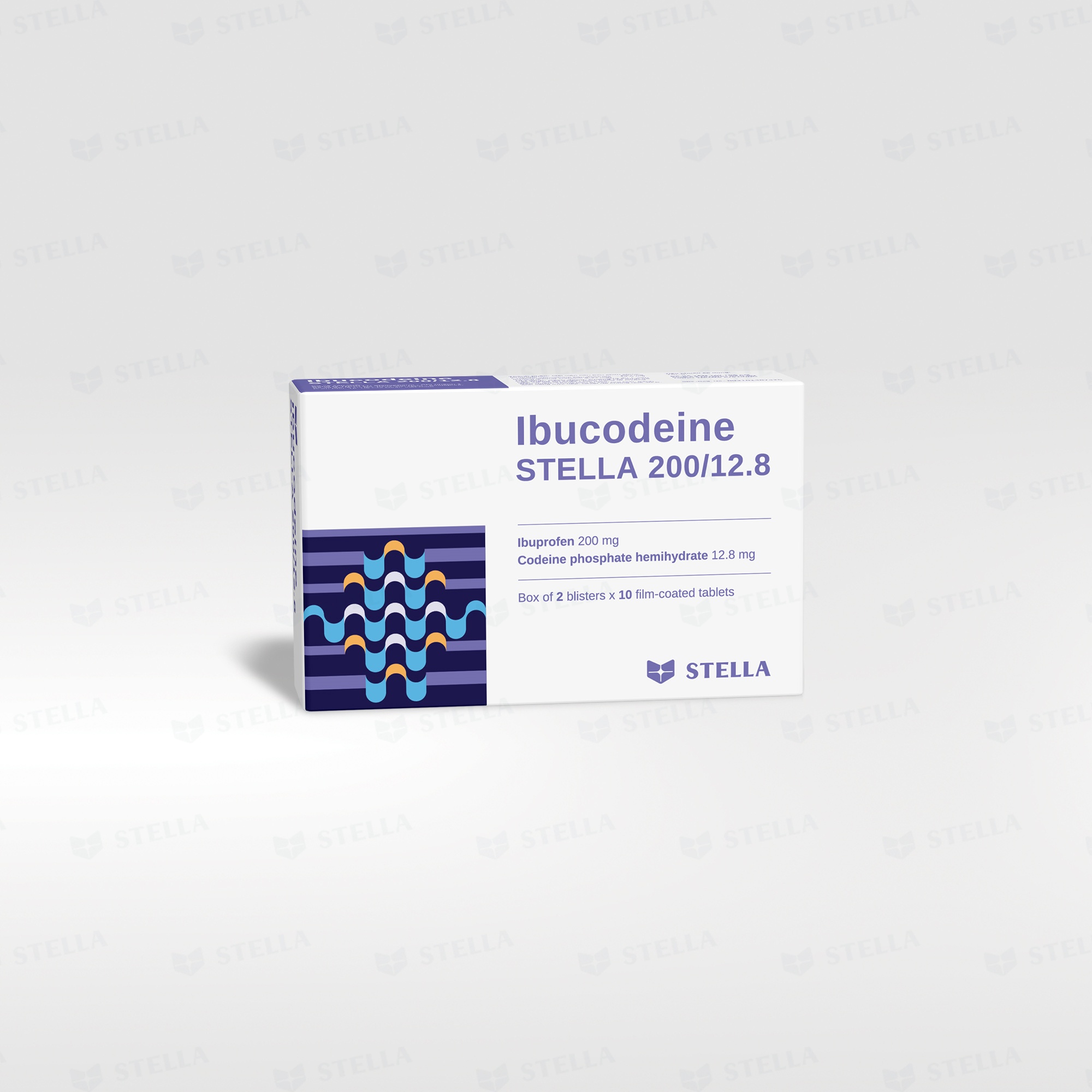
Ibucodeine STELLA 200/12.8
OTC

Ibuprofen is a NSAID that helps reduce pain and inflammation. When combined with codeine (an opioid), it helps inhibit pain signals from the brain.

Pack size Box of 20 tablets, 30 tablets, 60 tablets
Shelf-life 24 months
Composition Ibuprofen 200 mg
Codeine phosphate hemihydrate 12.8 mg (as codeine 9.43 mg)

Dosage forms and strengths Film-coated tablet
Product code :

PRESCRIBING INFORMATION

Indications

  • Indicated in patients older than 12 years of age for the short-term treatment of acute moderate pain which is not considered to be relieved by other analgesics (e.g. paracetamol, ibuprofen or aspirin) alone, such as: rheumatic and muscular pain, backache, neuralgia, migraine, headache, dental pain, dysmenorrhoea.

Dosage

  • Adults, the elderly and children over 18 years:
    One or two tablets every four to six hours.
    Do not take more than 6 tablets in 24 hours.
    Leave at least four hours between doses.
  • Children 12 -18 years:
    One or two tablets  every 6 hours.
    Do not take more than 6 tablets in 24 hours.
  • Children under 12 years:
    Should not use this medicine.
  • Ibucodeine STELLA 200/12.8 should not be used in a duration longer than three days. If no effective pain relief is achieved the patients/carers should be advised to seek the views of a healthcare professional.
  • Do not take more than 240 mg codeine in 24 hours.
    Leave at least four hours between doses and do not take more than 1200mg ibuprofen in any 24-hour period. Dosage should be adjusted accordingly to meet the specific requirements of other active ingredients combined with codeine in the product.
  • No special dosage modifications are required for elderly patients, unless renal or hepatic function is impaired, in which case dosage should be assessed individually.

Administration

  • For oral use, in short term only.
  • Codeine should be used at the lowest effective dose for the shortest period of time necessary to relieve symptoms.
  • Hypersensitivity to ibuprofen, codeine or any of the excipients in the product.
  • Children under 12 years.
  • In all paediatric patients (0-18 years of age) who undergo tonsillectomy and/or adenoidectomy for obstructive sleep apnoea syndrome due to an increased risk of developing serious and life threatening adverse reactions.
  • Last trimester of pregnancy.
  • In women during breastfeeding.
  • In patients for whom it is known they are CYP2D6 ultra-rapid metabolisers.
  • Patients who have previously shown hypersensitivity reactions (e.g. asthma, rhinitis, angioedema, or urticaria) in response to aspirin or other non-steroidal anti-inflammatory drugs.
  • Active or history of recurrent peptic ulcer/haemorrhage (two or more distinct episodes of proven ulceration or bleeding).
  • History of gastrointestinal bleeding or perforation, related to previous NSAIDs therapy.
  • Severe hepatic failure, renal failure or heart failure
  • In patients with respiratory depression, chronic constipation.

Possible adverse reactions

  • Non-specific allergic reactions and anaphylaxis.
  • Respiratory tract reactivity, e.g. asthma, aggravated asthma, bronchospasm, dyspnoea.
  • Various skin reactions, e.g. pruritus, urticaria, angioedema and more rarely exfoliative and bullous dermatoses (including epidermal necrolysis and erythema multiforme).
  • Masking of symptoms of underlying infections.
  • Bronchospasm may be precipitated in patients suffering from or with a previous history of bronchial asthma or allergic disease.
  • The use of this medicine with concomitant NSAIDs including cyclooxygenase-2 selective inhibitors should be avoided.
  • Systemic lupus erythematosus and mixed connective tissue disease due to increased risk of aseptic meningitis.
  • Renal impairment as renal function may further deteriorate.
    There is a risk of renal impairment in dehydrated children and adolescents.
    Severe hypokalaemia and renal tubular acidosis have been reported due to prolonged use of ibuprofen at higher than recommended doses. This risk is increased with the use of codeine/ibuprofen as patients may become dependent on the codeine component. Presenting signs and symptoms included reduced level of consciousness and generalised weakness. Ibuprofen induced renal tubular acidosis should be considered in patients with unexplained hypokalaemia and metabolic acidosis.
  • Hepatic dysfunction.
  • Risk of cardiovascular thrombosis. To minimize the risk of adverse events, Ibucodeine STELLA 200/12.8 should be used at the lowest effective daily dose for the shortest possible duration.
  • Cardiovascular and cerebrovascular effects. Caution (discussion with doctor or pharmacist) is required prior to starting treatment in patients with a history of hypertension and/or heart failure as fluid retention, hypertension and oedema have been reported in association with NSAID therapy.
    Clinical studies suggest that use of ibuprofen, particularly at a high dose (2400 mg/day) may be associated with a small increased risk of arterial thrombotic events (for example myocardial infarction or stroke). Overall, epidemiological studies do not suggest that low dose ibuprofen (e.g. ≤ 1200 mg/day) is associated with an increased risk of myocardial infarction.
    Cases of Kounis syndrome have been reported in patients treated with ibuprofen. Kounis syndrome has been defined as cardiovascular symptoms secondary to an allergic or hypersensitive reaction-associated with constriction of coronary arteries and potentially leading to myocardial infarction.
  • NSAIDs should be given with care to patients with a history of gastrointestinal disease (ulcerative colitis, Crohn’s disease) as these conditions may be exacerbated.
  • Severe cutaneous adverse reactions (SCARs) including exfoliative dermatitis, erythema multiforme, Stevens-Johnson syndrome (SJS), Toxic Epidermal Necrolysis (TEN), Drug Reactions with Eosinophilia and Systemic Symptoms (DRESS syndrome), and acute generalised exanthematous pustulosis (AGEP), which can be life-threatening or fatal, have been reported in association with the use of ibuprofen. Most of these reactions occurred within the first month.
    If signs and symptoms suggestive of these reactions appear this medicine should be withdrawn immediately and an alternative treatment considered (as appropriate).
  • Tolerance, physical and psychological dependence and opioid use disorder (OUD) may develop upon repeated administration of opioids such as codeine. Abuse or intentional misuse of Ibucodeine STELLA 200/12.8 film-coated Tablets may result in overdose and/or death.
  • Codeine is metabolised by the liver enzyme CYP2D6 into morphine, its active metabolite. If a patient has a deficiency or is completely lacking this enzyme an adequate analgesic effect will not be obtained.
  • Codeine is not recommended for use in children in whom respiratory function might be compromised including neuromuscular disorders, severe cardiac or respiratory conditions, upper respiratory or lung infections, multiple trauma or extensive surgical procedures.
  • Codeine is not recommended in children and adolescents between 12 and 18 years who have breathing problems, who are obese or have conditions such as obstructive sleep apnea or severe lung disease, which may increase the risk of serious respiratory problems.
  • Ibucodeine STELLA 200/12.8 contains less than 1 mmol sodium (23 mg) per tablet that is to say essentially “sodium free”.
  • Last trimester of pregnancy.
  • In women during breastfeeding.
  • Patients may become dizzy or sedated with this medicine. If affected, patients should not drive or operate machinery.
    This medicine can impair cognitive function and can affect a patient’s ability to drive safely.
