PRODUCT FILTER
Categories
Type
Type

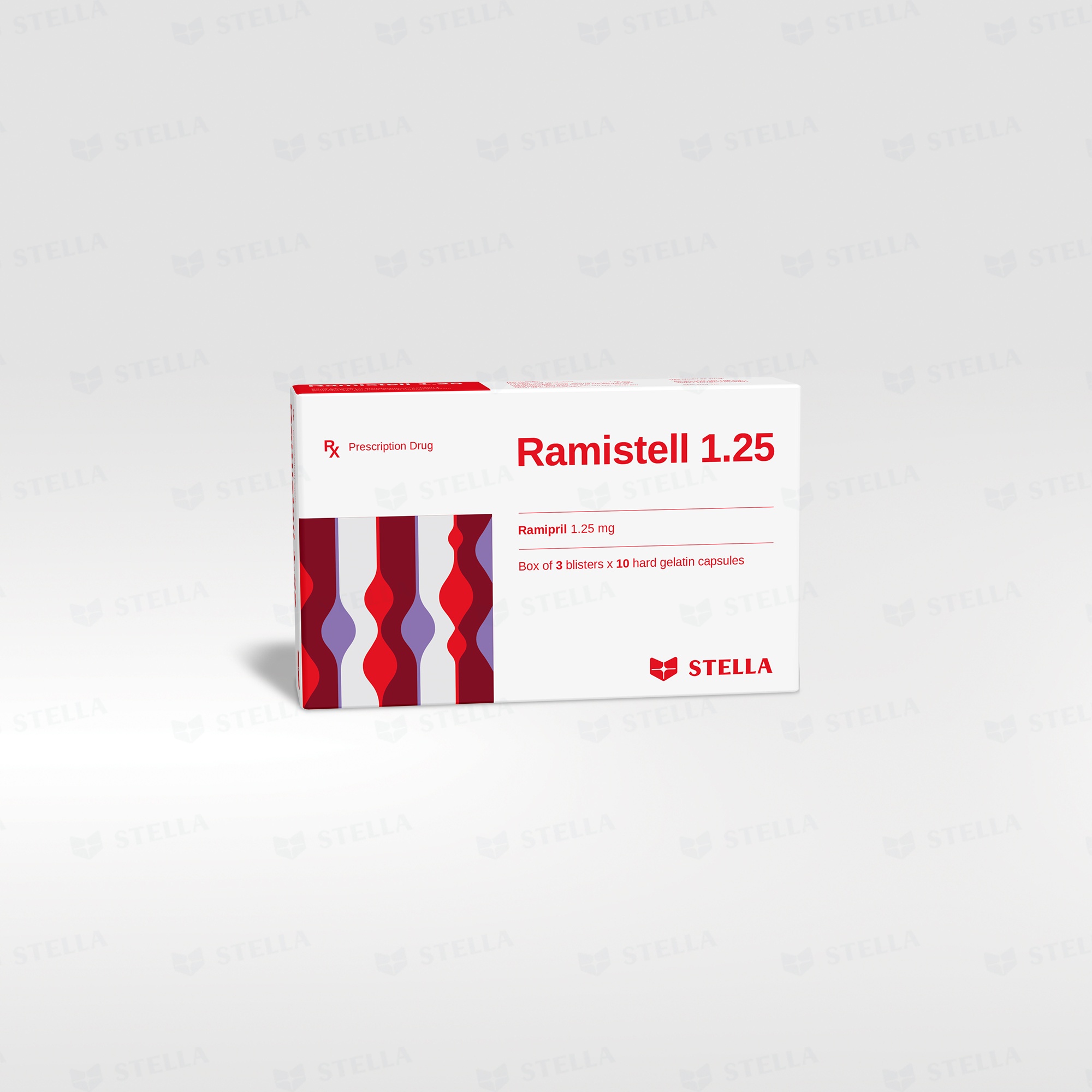
Ramistell 1.25
Rx

Ramipril belongs to the ACE inhibitor class of drugs, which dilate blood vessels to improve blood flow.

Pack size Box of 30 capsules, 60 capsules, 100 capsules
Shelf-life 24 months
Composition Ramipril
Dosage forms and strengths Hard gelatin capsule: 1.25 mg
Product code :

PRESCRIBING INFORMATION

Indications

  • Treatment of hypertension (Helps lower blood pressure and prevent stroke and myocardial infarction).
  • Treatment of symptomatic heart failure (Congestive heart failure or heart failure after myocardial infarction).
  • Reduction of cardiovascular risk (Prevention of cardiovascular events in high-risk individuals).
  • Protection of the kidneys, especially in diabetic patients with renal complications.

Dosage

  • The standard starting dose in many cases should be the lowest dose (1.25 mg).
  • If taking diuretics, usually start with a dose of 1.25 mg. Monitor renal function and serum potassium. Adjust the dose according to the individual patient’s response to the medication, along with blood pressure control.
  • Adults with Hypertension:
    The dose should be individualised according to the patient profile and blood pressure control. Ramipril may be used in monotherapy or in combination with other classes of antihypertensive medicinal products.
    Recommended starting dose of 2.5 mg daily. If  experience an excessive drop in blood pressure following the initial dose, a starting dose of 1.25 mg is recommended and the initiation of treatment should take place under medical supervision.
    The dose can be doubled at interval of two to four weeks to progressively achieve target blood pressure; the maximum permitted dose of ramipril is 10 mg daily.
  • Cardiovascular prevention
    The recommended initial dose is 2.5 mg of ramipril once daily. Depending on the patient’s tolerability to the active substance, the dose should be gradually increased.
  • Treatment of renal disease
    Usually started at a dose of 2.5 mg/day (or 1.5 mg depending on the patient’s condition) for the treatment of diabetic nephropathy, then adjusted based on blood pressure, renal function, and patient tolerance. The usual maintenance dose is 5-10 mg/day.
  • Symptomatic heart failure
    Recommended initial dose is 1.25 mg daily. Ramipril should be titrated by doubling the dose every one to two weeks up to a maximum daily dose of 10 mg. Two administrations per day are preferable.
  • Secondary prevention after acute myocardial infarction and with heart failure
    After 48 hours, following myocardial infarction in a clinically and haemodynamically stable patient, the starting dose is 2.5 mg twice daily for three days. If the initial 2.5 mg dose is not tolerated a dose of 1.25 mg twice a day should be given for two days before increasing to 2.5 mg and 5 mg twice a day. If the dose cannot be increased to 2.5 mg twice a day the treatment should be withdrawn.
    The daily dose is subsequently increased by doubling the dose at intervals of one to three days up to the target maintenance dose of 5 mg twice daily. The maintenance dose is divided in 2 administrations per day where possible. If the dose cannot be increased to 2.5 mg twice a day treatment should be withdrawn.
  • Patients with hepatic and renal impairment
    Daily dose in patients with renal impairment should be based on creatinine clearance.
  • Elderly
    Initial doses should be lower and subsequent dose titration should be more gradual because of greater chance of undesirable effects especially in very old and frail patients.

Usage

  • Administered orally.
  • It is recommended that ramipril is taken each day at the same time of the day.
  • Can be taken before, with or after meals.
  • Ramipril capsule has to be swallowed with liquid, should not be crushed, chewed or opened.
  • Hypersensitivity to the active substance, to any of the excipients or any other ACE inhibitors.
  • History of angioedema (hereditary, idiopathic or due to previous angioedema with ACE inhibitors).
  • Concomitant use with sacubitril/valsartan therapy.
  • Extracorporeal treatments leading to contact of blood with negatively charged surfaces.
  • Significant bilateral renal artery stenosis or renal artery stenosis in a single functioning kidney.
  • Second and third trimester of pregnancy.
  • Ramipril must not be used in patients with hypotensive or haemodynamically unstable states.
  • The concomitant use of ramipril with aliskiren-containing products is contraindicated in patients with diabetes mellitus or renal impairment.
  • Persistent dry cough ,
  • Reactions due to hypotension,
  • Angioedema,
  • Hyperkalaemia,
  • Renal or hepatic impairment, pancreatitis,
  • Severe skin reactions
  • Neutropenia/agranulocytosis.
  • Ramipril should not be initiated during pregnancy and lactation.
  • Patients at particular risk of hypotension are recommended to correct dehydration, hypovolaemia or salt depletion before initiating treatment. In patients with heart failure, however, such corrective action must be carefully weighed out against the risk of volume overload, and must be under medical supervision.
  • ACE-inhibitors and angiotensin II receptor blockers should not be used concomitantly in patients with diabetic nephropathy.
  • Treatment with ramipril should be discontinued where possible one day before surgery.
  • Renal function should be assessed before and during treatment and dose adjusted especially in the initial weeks of treatment. Particularly careful monitoring is required in patients with renal impairment. There is a risk of impairment of renal function, particularly in patients with congestive heart failure or after a renal transplant.
  • The combination of ramipril with sacubitril/valsartan is contraindicated due to the increased risk of angioedema. In case of angioedema, ramipril must be discontinued. Intestinal angioedema has been reported in patients treated with ramipril, presented with abdominal pain (with or without nausea or vomiting).
  • The likelihood and severity of anaphylactic and anaphylactoid reactions to insect venom and other allergens are increased under ACE inhibition. A temporary discontinuation of ramipril should be considered prior to desensitization.
  • Some adverse effects (e.g. symptoms of a reduction in blood pressure such as dizziness) may impair the patient’s ability to concentrate and react. This can happen especially at the start of treatment, or when changing over from other preparations. After the first dose or subsequent increases in dose it is not advisable to drive or operate machinery for several hours.