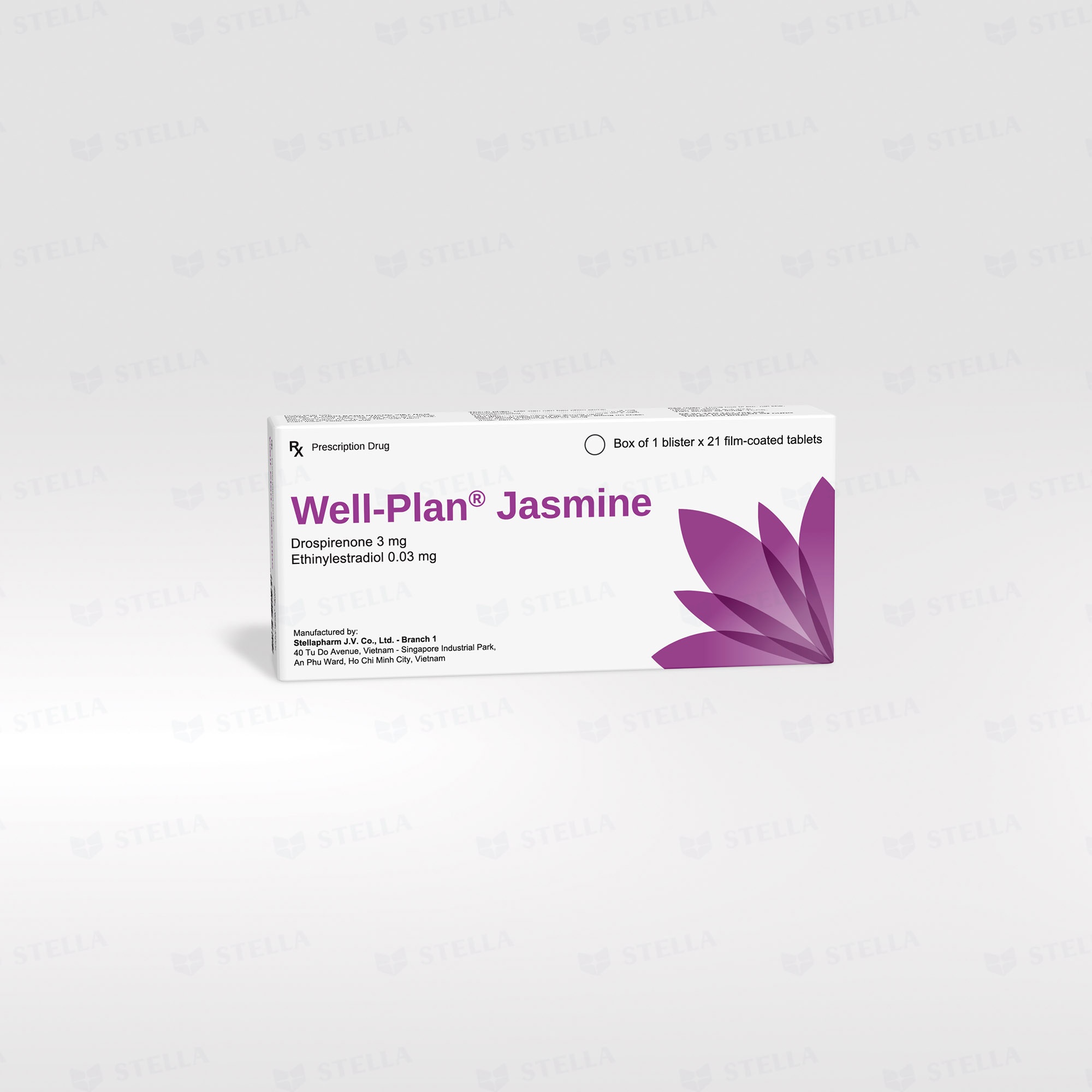
Indications
How to take Well-Plan® Jasmine
- Combined oral contraceptives, when taken correctly, have a failure rate of approximately 1% per year. The failure rate may increase when pills are missed or taken incorrectly.
- The tablets must be taken every day at about the same time, if necessary with a little liquid, in the order shown on the blister pack. One tablet is to be taken daily for 21 consecutive days. Each subsequent pack is started after a 7-day tablet-free interval.
How to start Well-Plan® Jasmine
- No preceding hormonal contraceptive use (in the past month)
Tablet-taking has to start on day 1 of the woman’s natural cycle (i.e. the first day of her menstrual bleeding).
- Changing from a combined hormonal contraceptive (combined oral contraceptive (COC), vaginal ring, or transdermal patch)
The woman should start with Well-Plan® Jasmine preferably on the day after the last active tablet (the last tablet containing the active substances) of her previous COC, but at the latest on the day following the usual tablet-free or placebo tablet interval of her previous COC. In case a vaginal ring or transdermal patch has been used, the woman should start using Well-Plan® Jasmine preferably on the day of removal, but at the latest when the next application would have been due.
- Changing from a progestogen-only-method (progestogen-only pill, injection, implant) or from a progestogen-releasing intrauterine system (IUS)
The woman may switch any day from the progestogen-only pill (from an implant or the IUS on the day of its removal, from an injectable when the next injection would be due) but should in all of these cases be advised to additionally use a barrier method for the first 7 days of tablet taking.
- Following first-trimester abortion
The woman may start immediately. When doing so, she need not take additional contraceptive measures.
- Following delivery or second-trimester abortion
Women should be advised to start at day 21 to 28 after delivery or second-trimester abortion.
When starting later, the woman should be advised to additionally use a barrier method for the first 7 days. However, if intercourse has already occurred, pregnancy should be excluded before the actual start of COC use or the woman has to wait for her first menstrual period.
Management of missed tablets
- If the user is less than 12 hours late in taking any tablet, contraceptive protection is not reduced. The woman should take the tablet as soon as she remembers and should take further tablets at the usual time.
- If she is more than 12 hours late in taking any tablet, contraceptive protection may be reduced.
The management of missed tablets can be guided by the following two basic rules:
+ Tablet-taking must never be discontinued for longer than 7 days.
+ 7 days of uninterrupted tablet-taking are required to attain adequate suppression of the hypothalamic-pituitary-ovarian-axis.
Accordingly the following advice can be given in daily practice:
Week 1
- The user should take the last missed tablet as soon as she remembers, even if this means taking two tablets at the same time. She then continues to take tablets at her usual time. In addition, a barrier method such as a condom should be used for the next 7 days. If intercourse took place in the preceding 7 days, the possibility of a pregnancy should be considered. The more tablets are missed and the closer they are to the regular tablet-free interval, the higher the risk of a pregnancy.
Week 2
- The user should take the last missed tablet as soon as she remembers, even if this means taking two tablets at the same time. She then continues to take tablets at her usual time. Provided that the woman has taken her tablets correctly in the 7 days preceding the first missed tablet, there is no need to use extra contraceptive precautions. However, if this is not the case, or if she has missed more than 1 tablet, the woman should be advised to use extra precautions for 7 days.
Week 3
- The risk of reduced reliability is imminent because of the forthcoming 7 day tablet-free interval. However, by adjusting the tablet-intake schedule, reduced contraceptive protection can still be prevented. By adhering to either of the following two options, there is therefore no need to use extra contraceptive precautions, provided that in the 7 days preceding the first missed tablet the woman has taken all tablets correctly. If this is not the case, she should follow the first of these two options and use extra precautions for the next 7 days as well.
The user should take the last missed tablet as soon as she remembers, even if this means taking two tablets at the same time. She then continues to take tablets at her usual time.
The next blister pack must be started as soon as the current blister pack is finished, i.e., no gap should be left between packs. The user is unlikely to have a withdrawal bleed until the end of the second pack, but she may experience spotting or breakthrough bleeding on tablet-taking days.
The woman may also be advised to discontinue tablet-taking from the current blister pack. She should then have a tablet-free interval of up to 7 days, including the days she missed tablets, and subsequently continue with the next blister pack. If the woman missed tablets and subsequently has no withdrawal bleed in the first normal tablet-free interval, the possibility of a pregnancy should be considered.
Advice in case of gastrointestinal disturbances
- In cases of severe gastrointestinal disturbances (e.g. vomiting or diarrhea), absorption of a tablet may not be complete; additional contraceptive measures must therefore be taken. If vomiting occurs within 3 to 4 hours after taking a tablet, a new tablet should be taken as a replacement as soon as possible. The new tablet should be taken if possible within 12 hours of the usual time of taking it.
- If more than 12 hours have passed, the same instructions as those given for forgotten tablets more than 12 hours must be applied (see section Management of missed tablets).
- If the woman does not want to change the normal tablet-taking schedule, the extra tablet(s) from another pack should be taken.
How to postpone a withdrawal bleed
- To delay a period the woman should continue with another blister pack of Well-Plan® Jasmine without a tablet-free interval. The extension can be carried on for as long as wished until the end of the second pack. During the extension the woman may experience breakthrough bleeding or spotting.
- Regular intake of Well-Plan® Jasmine is then resumed after the usual 7-day tablet-free interval. To shift her periods to another day of the week than the woman is used to with her current scheme, she can be advised to shorten her forthcoming tablet-free interval by as many days as she likes. The shorter the interval, the higher the risk that she does not have a withdrawal bleed and will experience breakthrough bleeding and spotting during the subsequent pack (just as when delaying a period).
Additional information on special populations
- Well-Plan® Jasmine is only indicated after menarche.
- Well-Plan® Jasmine is not indicated after menopause.
- Well-Plan® Jasmine is contraindicated in women with severe hepatic diseases, with renal impairment, with severe renal insufficiency or acute renal failure.