PRODUCT FILTER
Categories
Type
Type

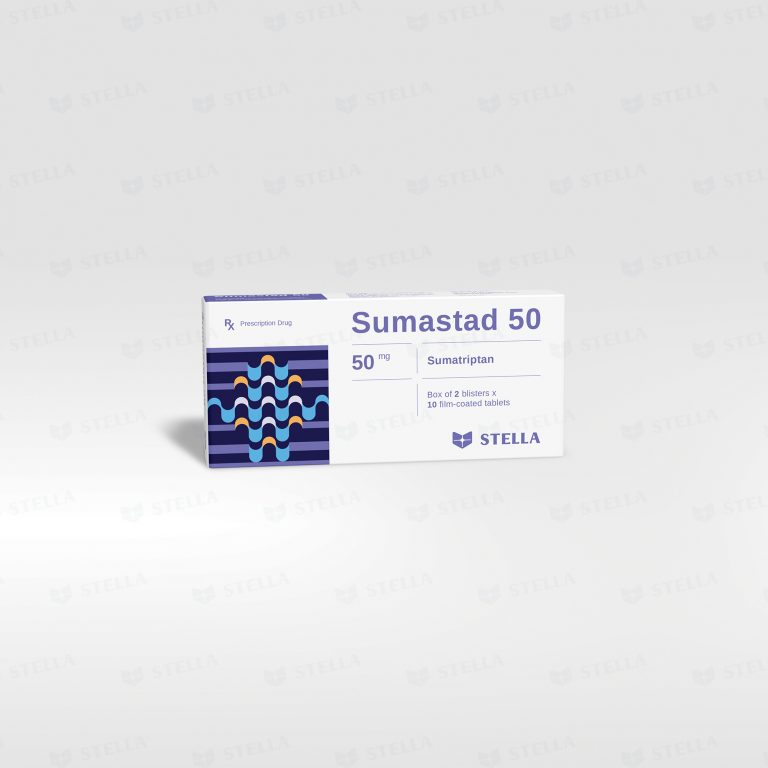
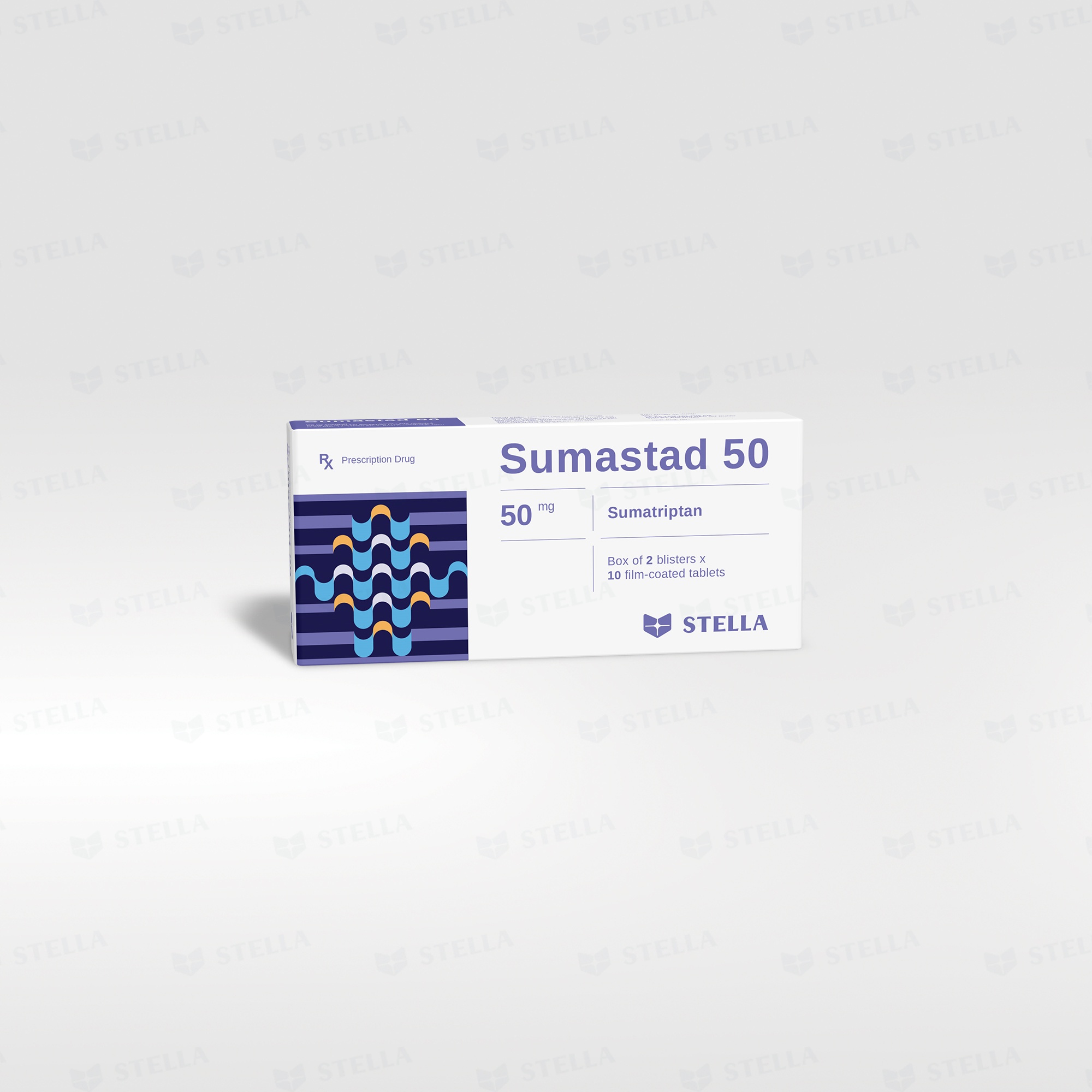
Sumastad 50
Rx

Sumatriptan is indicated for the acute intermittent treatment of migraine. It should not be used prophylactically. The recommended dose of sumatriptan should not be exceeded.

Pack size Box of 10 tablets, 20 tablets
Shelf-life 24 months
Composition Sumatriptan
Dosage forms and strengths Film-coated tablet: 50 mg
Product code :

PRESCRIBING INFORMATION

Indications

  • For the acute treatment of migraine attacks, with or without aura.
  • Sumatriptan should only be used where there is a clear diagnosis of migraine.

Dosage

  • It is advisable that sumatriptan be given as early as possible after the onset of migraine attack but it is equally effective at whatever stage of the attack it is administered.
  • The recommended dose of oral sumatriptan is a single 50 mg tablet. Some patients may require 100 mg.
  • If the patient has responded to the first dose, but the symptoms recur a second dose may be given provided that there is a minimum interval of 2 hours between the two doses.
  • No more than 300 mg should be taken in any 24-hour period.
  • Patients who do not respond to the prescribed dose of sumatriptan should not take a second dose for the same attack. In these cases the attack can be treated with paracetamol, acetylsalicylic acid (aspirin) or non-steroidal anti-inflammatory drugs. Sumatriptan may be taken for subsequent attacks.
  • Sumatriptan should not be given concomitantly with ergotamine or derivatives of ergotamine (including methysergide).
  • Low doses of 25 – 50 mg should be considered for patients with mild to moderate hepatic impairment.
  • Sumatriptan should be used with caution in patients with renal impairment.

Administration

  • Sumastad 50 tablet should be swallowed whole with water.


  • Do not exceed the prescribed dose.
  • Sumatriptan should not be used for children aged under 17 and in patients aged over 65 years.
  • Hypersensitivity with sumatriptan or to any of the excipients.
  • Patients who have had myocardial infarction or have ischaemic heart disease, coronary vasospasm (Prinzmetal’s angina), peripheral vascular disease or patients who have symptoms or signs consistent with ischaemic heart disease.
  • Patients with a history of cerebrovascular accident (CVA) or transient ischaemic attack (TIA).
  • Patients with severe hepatic impairment.
  • In patients with moderate or severe hypertension and mild uncontrolled hypertension is contraindicated.
  • The concomitant administration of ergotamine, or derivatives of ergotamine (including methysergide) or any triptan/5 hydroxytryptamine 1 (5-HT1) receptor agonist is contraindicated.
  • Concurrent administration of reversible (e.g. moclobemide) or irreversible (e.g. selegiline) monoamine oxidase inhibitors (MAOIs) and sumatriptan is contraindicated. Sumatriptan must not be used within 2 weeks of discontinuation of therapy with monoamine oxidase inhibitors.

Possible side effects:

  • Dizziness, drowsiness, sensory disturbance including paraesthesia and hypoaesthesia.
  • Transient increases in blood pressure arising soon after treatment; flushing.
  • Dyspnoea.
  • Nausea and vomiting.
  • Sensations of heaviness (usually transient, may be intense and can affect any part of the body including the chest and throat); myalgia.
  • Pain, sensations of heat or cold, pressure or tightness (these events are usually transient and may be intense and affect any part of the body including the chest and throat).
  • Feelings of weakness, fatigue (both events are mostly mild to moderate in intensity and transient).
  • Sumatriptan should only be used where there is a clear diagnosis of migraine.
  • Sumatriptan is not indicated for use in the management of hemiplegic, basilar or ophthalmoplegic migraine.
  • Before treating with sumatriptan, care should be taken to exclude potentially serious neurological conditions if the patient presents with atypical symptoms or if they have not received an appropriate diagnosis for sumatriptan use.
  • Following administration, sumatriptan can be associated with transient symptoms including chest pain and tightness which may be intense and involve the throat.
  • Where such symptoms are thought to indicate ischaemic heart disease, no further doses of sumatriptan should be given and an appropriate evaluation should be carried out.
  • Sumatriptan should not be given to patients with risk factors for ischaemic heart disease, including those patients who are heavy smokers or users of nicotine substitution therapies, without prior cardiovascular evaluation. Special consideration should be given to postmenopausal women and males over 40 with these risk factors.
  • Sumatriptan should be administered with caution to patients with mild controlled hypertension, since transient increases in blood pressure and peripheral vascular resistance have been observed in a small proportion of patients.
  • Sumatriptan should be used with caution in patients with mild, well-controlled hypertension.
  • Serotonin syndrome (altered mental status, autonomic nervous system manifestations, and neuromuscular disorders) has occurred but is rare after concomitant use with a selective serotonin reuptake inhibitor and sumatriptan. Patients should be closely monitored. A triptan/5-HT1 agonist should not be combined with sumatriptan.
  • Sumatriptan should be administered with caution to patients with conditions that may affect significantly the absorption, metabolism or excretion of the drugs, e.g. impaired hepatic (Child Pugh grade A or B) or renal function.
  • Sumatriptan should be used with caution in patients with a history of seizures or other risk factors which lower the seizure threshold.
  • Caution should be exercised before using sumatriptan in patients with known hypersensitivity to sulphonamides.
  • Undesirable effects may be more common during concomitant use of triptans and herbal preparations containing St John’s Wort (Hypericum perforatum).
  • Sumatriptan should only be administered to pregnant women after careful consideration of the benefits and risks to the foetus.
  • Avoiding breast-feeding for 12 hours after the administering sumatriptan.
  • Drowsiness may occur as a result of migraine or treatment with sumatriptan. This may influence the ability to drive and to operate machinery.