PRODUCT FILTER
Categories
Type
Type

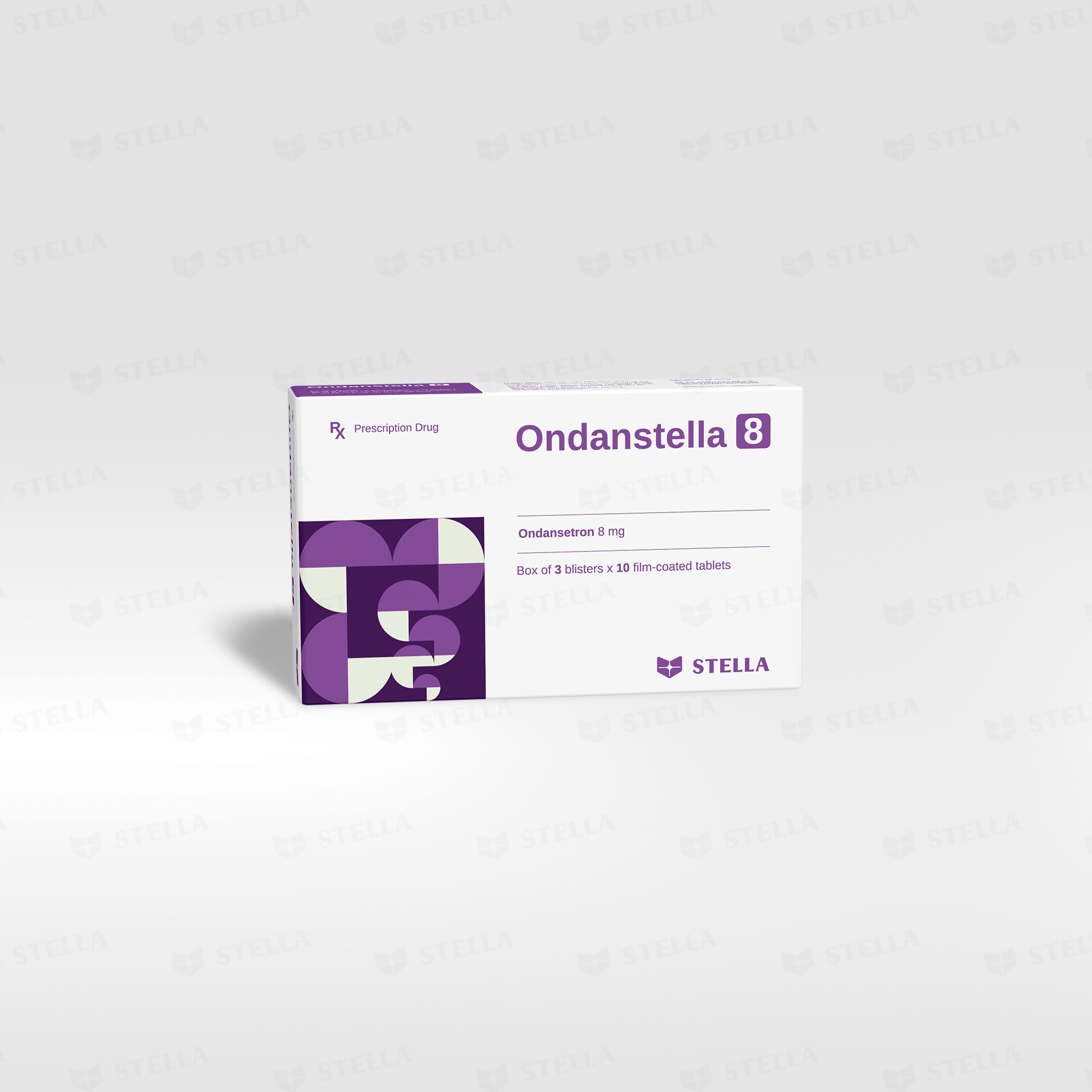
Ondanstella 8
Rx

Ondansetron is a potent, highly selective 5-HT3 receptor-antagonist. Its precise antiemetic and antinauseal mechanism of action is not known. Chemotherapeutic agents and radiotherapy may cause release of 5-HT in the small intestine initiating a vomiting reflex by activating vagal afferents via 5-HT3 receptors.

Pack size Box of 30 tablets, 50 tablets, 100 tablets
Shelf-life 24 months
Composition Ondansetron
Dosage forms and strengths Film-coated tablet: 8 mg
Product code :

PRESCRIBING INFORMATION

Indications

  • For the management of nausea and vomiting induced by cytotoxic chemotherapy and radiotherapy,
  • For the prevention and treatment of post-operative nausea and vomiting.

Dosage

  • Adults
    Chemotherapy and radiotherapy-induced vomiting:
    Take 8 mg 1–2 hours before treatment, followed by 8 mg 12 hours later.
    To combat prolonged and persistent vomiting after the first 24 hours, ondansetron should be continued for 5 days after the treatment course. The recommended dose is 8 mg twice daily.
    Highly emetic chemotherapy:
    A single dose of up to 24 mg of ondansetron may be administered orally with 12 mg dexamethasone sodium phosphate 1–2 hours before chemotherapy.
    To limit delayed or prolonged vomiting after the first 24 hours, oral or rectal ondansetron treatment should be continued for up to 5 days after a treatment course. The recommended oral dose is 8 mg twice daily.
    Post-surgical nausea and vomiting:
    Prevention: 16 mg 1 hour before anesthesia. Alternatively, administer 8 mg one hour before anesthesia, followed by two more 8 mg doses 8 hours apart.
    Treatment: Should be administered by injection.
  • Children
    The dose for chemotherapy-induced nausea and vomiting in children aged 6 months and older and adolescents can be calculated based on body surface area (BSA) or weight. Weight-based dosing results in higher total daily doses compared to body surface area – based dosing.
  • Elderly
    Ondansetron is well tolerated by patients over 65 years and no alteration of dosage, dosing frequency or route of administration are required.
  • Patients with renal impairment
    No alteration of daily dosage or frequency of dosing, or route of administration are required.
  • Patients with hepatic impairment
    Total daily dose of 8 mg should not be exceeded.
  • Patients with poor sparteine/debrisoquine metabolism
    No alteration of daily dosage or frequency of dosing is required.

Usage

  • Ondanstella 8 is orally administered.
  • Patients with hypersensitivity to ondansetron or to any of the excipients.
  • Hypersensitivity to other selective 5-HT3 receptor antagonists (e.g. granisetron, dolasetron).
  • Concomitant use with apomorphine is contraindicated.

Very common

  • Headache.

Common

  • Sensation of warmth or flushing.
  • Constipation.
  • Ondansetron prolongs the QT interval in a dose-dependent manner. Ondansetron should be administered with caution to patients who have or may develop prolongation of QTc, including patients with electrolyte abnormalities, congestive heart failure, bradyarrhythmias or patients taking other medicinal products that lead to QT prolongation or electrolyte abnormalities.
  • Cases of myocardial ischemia have been reported in patients treated with ondansetron.
  • Hypokalemia and hypomagnesemia should be corrected prior to ondansetron administration.
  • There have been post-marketing reports describing patients with serotonin syndrome (including altered mental status, autonomic instability and neuromuscular abnormalities) following the concomitant use of ondansetron and other  serotonergic drugs (including selective serotonin reuptake inhibitors – SSRI and serotonin noradrenaline reuptake inhibitors – SNRI).
  • As ondansetron is known to increase large bowel transit time, patients with signs of subacute intestinal obstruction should be monitored following administration.
  • In patients with adenotonsillar surgery prevention of nausea and vomiting with ondansetron may mask occult bleeding.
  • Caution should be exercised if ondansetron is co-administered with anaesthetics to patients with arrhythmias or cardiac conduction disorders or to patients who are being treated with antiarrhythmic agents or beta-blockers.
  • Respiratory events should be treated symptomatically, and should pay particular attention to them as precursors of hypersensitivity reactions.
  • Pediatric patients receiving ondansetron with hepatotoxic chemotherapeutic agents should be monitored closely for impaired hepatic function.
  • Ondanstella contains lactose. Patients with rare hereditary problems of galactose intolerance, total lactase deficiency or glucose-galactose malabsorption should not take this medicine.
  • Ondansetron should not be used during the first trimester of pregnancy and breast-feeding.
  • Ondansetron has no or negligible influence on the ability to drive and use machines