PRODUCT FILTER
Categories
Type
Type

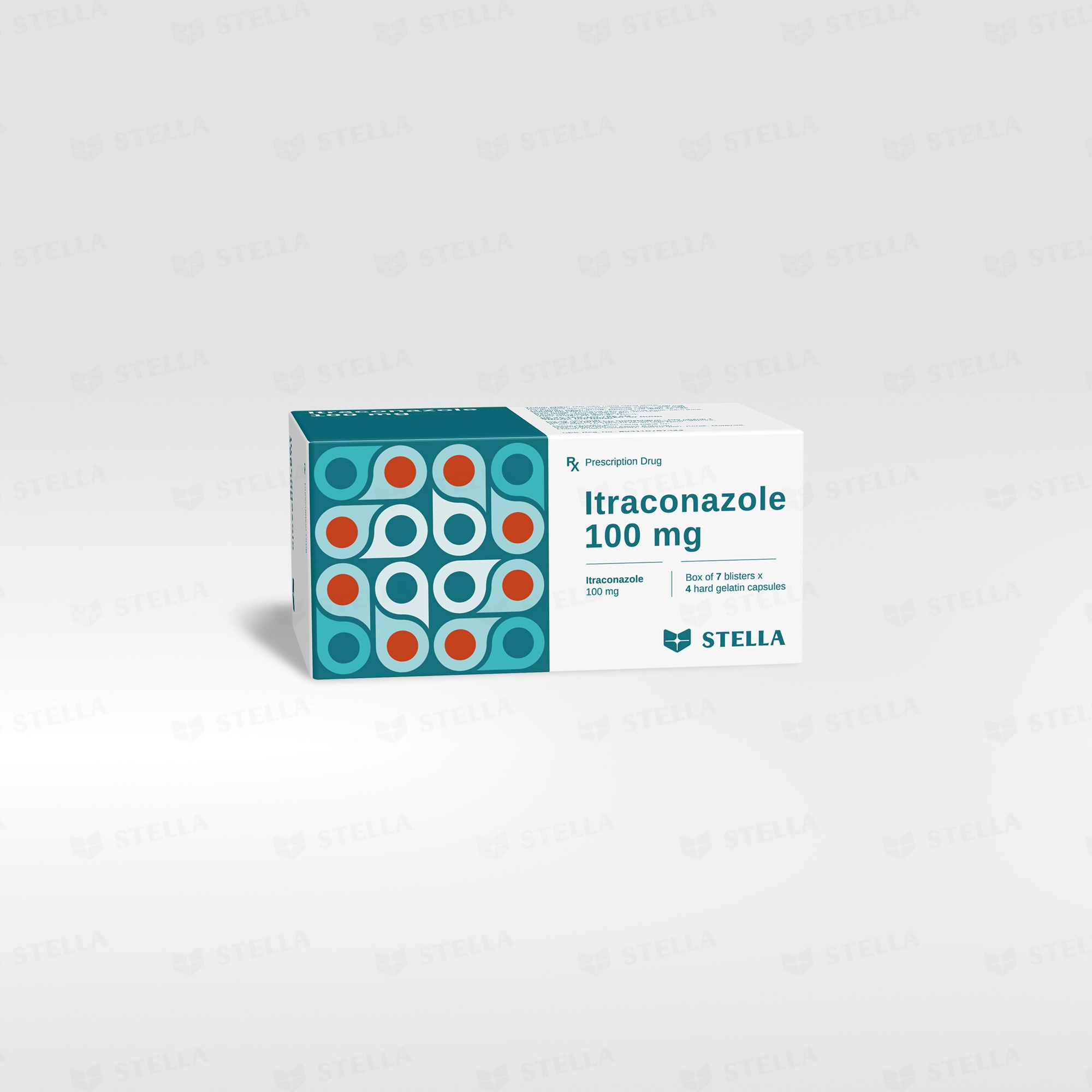
Itraconazole 100 mg
Rx

Itraconazole, a synthetic triazole derivative, is an antifungal agent. Itraconazole inhibits cytochrome P450-depent enzymes in sensitive fungi resulting in impairment of ergosterol synthesis in fungal cell membranes.

Pack size Box of 28 capsules
Shelf-life 36 months
Composition Itraconazole
Dosage forms and strengths Hard gelatin capsule: 100 mg
Product code :

PRESCRIBING INFORMATION

Indications

  • Vulvovaginal candidosis, oropharyngeal candidosis.
  • Dermatophytoses caused by organisms susceptible to itraconazole (Trichophyton spp., Microsporum spp., Epidermophyton floccosum) e.g. tinea pedis, tinea cruris, tinea corporis, tinea manuum.
  • Pityriasis versicolor.
  • Onychomycosis caused by dermatophytes and/or yeasts.
  • The treatment of histoplasmosis.
  • Treatment of cryptococcosis (including cryptococcal meningitis)
  • Treatment of aspergillosis and candidosis.
  • Maintenance therapy in AIDS patients to prevent relapse of underlying fungal infection.
  • Prevention of fungal infection during prolonged neutropenia when standard therapy is considered inappropriate.

Dosage

Adults

  • Short-term therapy:
    Vulvovaginal candidosis: 200 mg twice daily for 1 day.
    Pityriasis versicolor: 200 mg once daily for 7 days.
    Tinea corporis, tinea cruris: 100 mg once daily for 15 days or 200 mg once daily for 7 days.
    Tinea pedis, tinea manuum: 100 mg once daily for 30 days.
    Oropharyngeal candidosis: 100 mg once daily for 15 days. Increase dose to 200 mg once daily for 15 days in AIDS or neutropenic patients because of impaired absorption in these groups.
    Onychomycosis (toenails with or without fingernail involvement): 200 mg once daily for 3 months.
    For skin, vulvovaginal and oropharyngeal infections, optimal clinical and mycological effects are reached 1 – 4 weeks after cessation of treatment and for nail infections, 6 – 9 months after the cessation of treatment. This is because elimination of itraconazole from skin, nails and mucous membranes is slower than from plasma.
  • The length of treatment for systemic fungal infections should be dictated by the mycological and clinical response to therapy:
    Aspergillosis: 200 mg once daily for 2 – 5 months. Increase dose to 200 mg twice daily in case of invasive or disseminated disease.
    Candidiasis: 100 – 200 mg once daily for 3 weeks to 7 months. Increase dose to 200 mg twice daily in case of invasive or disseminated disease.
    Non-meningeal cryptococcosis: 200 mg once daily for 10 weeks.
    Cryptococcal meningitis: 200 mg twice daily for 2 months to 6 months.
    Histoplasmosis: 200 mg once daily or twice daily for 8 months.
    Maintenance in AIDS: 200 mg once daily.
    Prophylaxis in neutropenia: 200 mg once daily.

Patients with impaired gastrointestinal motility 

  • When treating patients with severe fungal infections or in the prophylaxis of fungal infections in patients with impaired gastrointestinal motility, pateints should be carefully monitored and, if available, therapeutic drug monitoring should be considered.

Paediatric population

  • Not recommended.

Elderly patients, Patients with renal and hepatic impairment: 

  • Caution should be exercised when this drug is administered in these patient populations.

Administration

  • Itraconazole is for oral administration and must be taken immediately after a meal for maximal absorption.
  • Itraconazole are contraindicated in patients with known hypersensitivity to itraconazole or to any of the excipients.
  • Co-administration of a number of CYP3A4 substrates is contraindicated with itraconazole. Increased plasma concentrations of these drugs, caused by coadministration with itraconazole, may increase or prolong both therapeutic and adverse effects to such an extent that a potentially serious situation may occur. For example, increased plasma concentrations of some of these drugs can lead to QT prolongation and ventricular tachyarrhythmias including occurrences of torsade de pointes, a potentially fatal arrhythmia.
  • Itraconazole should not be administered to patients with evidence of ventricular dysfunction such as congestive heart failure (CHF) or a history of CHF except for the treatment of life-threatening or other serious infections.
  • Itraconazole must not be used during pregnancy (except for life-threatening cases).
  • Women of childbearing potential taking itraconazole should use contraceptive precautions. Effective contraception should be continued until the menstrual period following the end of itraconazole therapy.

Commons

  • Headache,
  • Abdominal pain, nausea.
  • Caution should be used in prescribing itraconazole to patients with hypersensitivity to other azoles.
  • Itraconazole has been shown to have a negative inotropic effect and itraconazole has been associated with reports of congestive heart failure, suggesting that the risk of heart failure might increase with the total daily dose of itraconazole.
  • Itraconazole should not be used in patients with congestive heart failure or with a history of congestive heart failure unless the benefit clearly outweighs the risk.
  • Caution should be used when co-administering itraconazole and calcium channel blockers due to an increased risk of congestive heart failure.
  • Liver function monitoring should be considered in patients receiving itraconazole treatment. It is recommended that patients with impaired hepatic function,patients with pre-existing hepatic function abnormalities or those who have experienced liver toxicity with other medications be carefully monitored when taking itraconazole.
  • The use of itraconazole is not recommended in paediatric patients, elderly, Patients with immediately life-threatening systemic fungal infections.
  • Caution should be exercised when this drug is administered in this patient population and adjusting the dose may be considered.
  • Transient or permanent hearing loss has been reported in patients receiving treatment with itraconazole.
  • If neuropathy occurs that may be attributable to itraconazole, the treatment should be discontinued.
  • Itraconazole 100 mg contains sucrose. Patients with rare hereditary problems of fructose intolerance, glucose-galactose malabsorption or sucrase-isomaltase insufficiency should not take this medicine.
  • Ssensitivity should be tested before the start of itraconazole therapy.
  • It is not recommended that itraconazole capsules and itraconazole oral solution be used interchangeably.
  • Itraconazole must not be used during pregnancy and breast-feeding except for life-threatening cases where the potential benefit outweighs the potential harms.
  • When driving vehicles and operating machinery the possibility of adverse reactions such as dizziness, visual disturbances and hearing loss, which may occur in some instances, must be taken into account.