PRODUCT FILTER
Categories
Type
Type

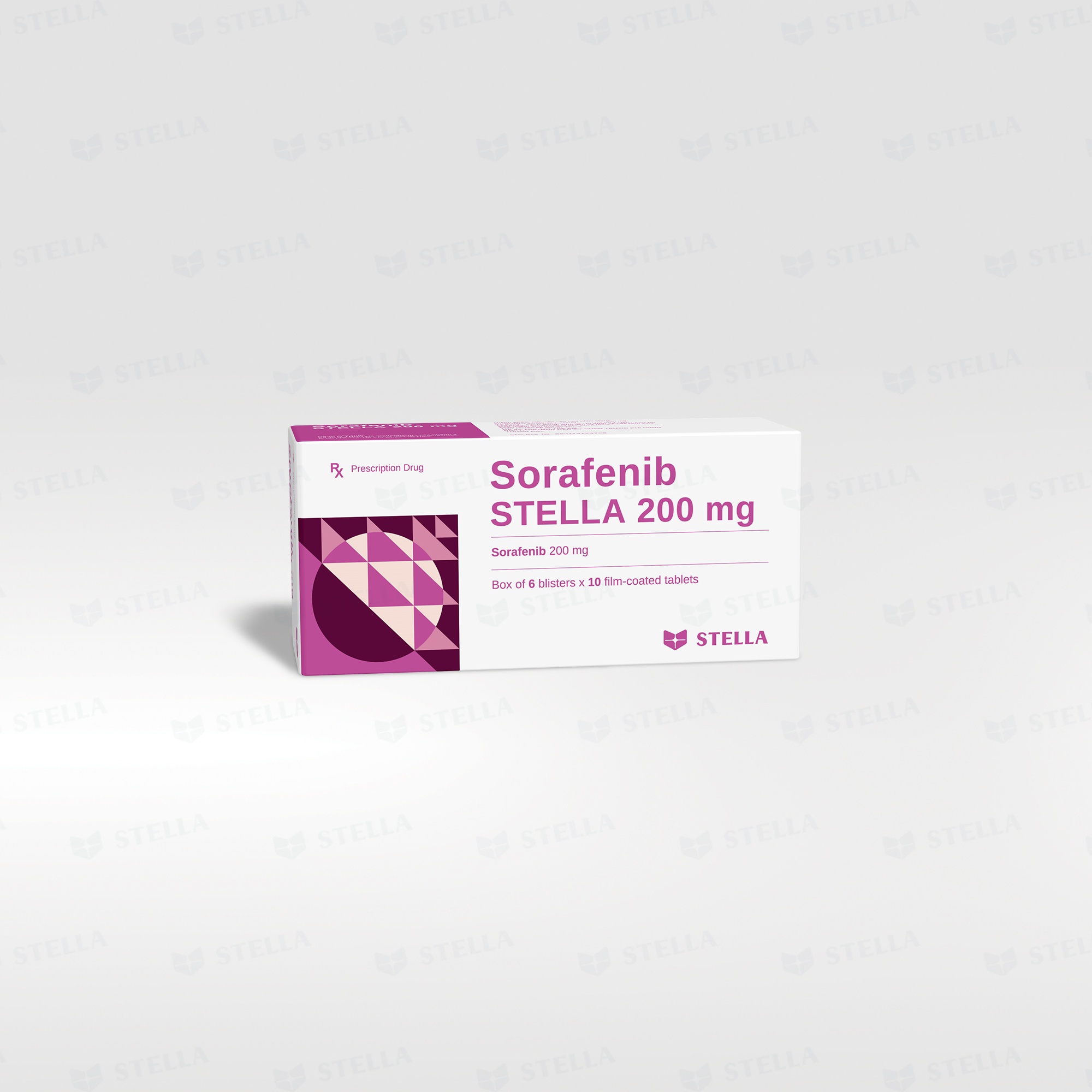
Sorafenib STELLA 200 mg
Rx

Sorafenib inhibited tumour growth of the human hepatocellular carcinoma, renal cell carcinoma, differentiated thyroid carcinoma and several other human tumour xenografts.

Pack size Box of 60 tablets, 100 tablets
Shelf-life 24 months
Composition Sorafenib (as sorafenib tosilate)
Dosage forms and strengths Film-coated tablet: 200 mg
Product code :

PRESCRIBING INFORMATION

Indications

  • Treatment of hepatocellular carcinoma;
  • Treatment of advanced renal cell carcinoma;
  • Treatment of differentiated thyroid carcinoma, refractory to radioactive iodine.

Dosage

Adults:

  • Recommended daily dose:
    400 mg (two 200 mg tablets) twice daily.
    Treatment is continued until the patient no longer derives benefit from the therapy or until unacceptable toxicity occurs.
  • Dose reduction:
    Management of adverse drug reactions may require temporary interruption or dose reduction of sorafenib.
    When dose reduction is required during the treatment of hepatocellular carcinoma and advanced renal cell carcinoma: Reduce the sorafenib dose to two 200 mg tablets taken once daily.
    Dose reduction during the treatment of differentiated thyroid carcinoma: Reduce the sorafenib dose to 600 mg daily, divided into two doses (two 200 mg tablets and one 200 mg tablet, 12 hours apart). If further dose reduction is necessary, the sorafenib dose may be reduced to one 200 mg tablet taken twice daily (total dose of 400 mg/day); subsequently, if needed, it may be further reduced to one 200 mg tablet taken once daily (total dose of 200 mg/day).
    The sorafenib dose may be increased following improvement of non-hematologic adverse reactions.

Special populations

  • No data are available on the safety and efficacy of sorafenib in pediatric patients.
  • No dose adjustment is required based on age (over 65 years), gender, or body weight.
  • Hepatic impairment: No dose adjustment is required for patients with mild (Child-Pugh A) or moderate (Child-Pugh B) hepatic impairment. No studies have been conducted on the use of sorafenib in patients with severe (Child-Pugh C) hepatic impairment.
  • Renal impairment: No dose adjustment is required for patients with mild, moderate, or severe renal impairment not requiring dialysis. No studies have been conducted on the use of sorafenib in patients requiring dialysis. Fluid and electrolyte balance should be monitored in patients at risk of renal dysfunction.

Administration

  • Sorafenib STELLA 200 mg may be taken without food or with a low- or moderate-fat meal. If a high-fat meal is consumed, sorafenib should be taken at least 1 hour before or 2 hours after the meal.
  • Swallow the tablet with some water.


  • Known hypersensitivity to sorafenib or to any of the excipients in the tablet.

Possible adverse reactions:

  • The most important serious:
    Myocardial infarction/ischaemia, gastrointestinal perforation, drug induced hepatitis, haemorrhage, and hypertension/hypertensive crisis.
  • The most common:
    Diarrhoea, fatigue, alopecia, infection, hand foot skin reaction and rash.
  • Sorafenib should not be used by pregnant or breastfeeding women.
  • Women of childbearing potential must be informed of the potential harm sorafenib poses to the fetus, including fetal malformations (teratogenicity), growth retardation, and stillbirth (embryo-fetal toxicity).
  • Dermatological Toxicities
    Hand-foot skin reaction (palmar-plantar erythrodysaesthesia) and rash represent the most common adverse drug reactions with sorafenib.
    Management of dermatologic toxicities may include topical therapies for symptomatic relief, temporary treatment interruption and/or dose modification of sorafenib, or in severe or persistent cases, permanent discontinuation of sorafenib.
  • Hypertension
    Hypertension was usually mild to moderate, occurred early in the course of treatment, and was amenable to management with standard anti-hypertensive therapy. In cases of severe or persistent hypertension, permanent discontinuation of sorafenib should be considered.
  • Haemorrhage
    An increase in the risk of bleeding may occur following sorafenib administration. If any bleeding event necessitates medical intervention, it is recommended that permanent discontinuation of sorafenib should be considered.
  • Warfarin
    Patients taking warfarin concomitantly should be monitored regularly for changes in prothrombin time, INR and for clinical bleeding episodes.
  • Wound Healing ComplicationsIn patients undergoing major surgical procedures, temporary interruption of sorafenib therapy is recommended for precautionary reasons. The decision to resume sorafenib therapy following a major surgical intervention should be based on clinical judgment of adequate wound healing.
  • Cardiac Ischemia and/or Infarction
    Temporary or permanent discontinuation of sorafenib should be considered in patients who develop cardiac ischaemia and/or infarction.
  • QT interval prolongation
    Sorafenib has been shown to prolong the QT/QTc interval, which may lead to an increased risk for ventricular arrhythmias. Use sorafenib with caution in patients who have, or may develop prolongation of QTc, such as patients with a congenital long QT syndrome, patients treated with a high cumulative dose of anthracycline therapy, patients taking certain anti-arrhythmic medicines or other medicinal products that lead to QT prolongation, and those with electrolyte disturbances such as hypokalemia, hypocalcemia or hypomagnesemia. When using sorafenib in these patients, periodic monitoring with on-treatment electrocardiograms and electrolytes (magnesium, potassium, calcium) should be considered.
  • Gastrointestinal perforation is an uncommon event and has been reported in less than 1% of patients taking sorafenib. Sorafenib therapy should be discontinued.
  • Hepatic Impairment. Since sorafenib is mainly eliminated via the hepatic route, exposure might be increased in patients with severe hepatic impairment.
  • Hypocalcaemia: When using sorafenib in patients with differentiated thyroid carcinoma, close monitoring of blood calcium level is recommended.
  • There is no evidence that sorafenib affects the ability to drive and operate machinery.